Monday, August 22, 2016

IOC Further demonstrates why it is a political agency

Ok, so ... let's follow this train of thought for a moment.

The US, primarily, and according to the article, pushed the IOC about Russia and doping.  Because the whole doping issue makes the IOC look bad, the IOC will take that out on LA's bid for the Olympics.

Yes.  Ok.  So, a question is - did any US athletes use any drugs to enhance their abilities in the last 14 days?  Not as far as anyone is aware.  Did any Ethiopian athletes use any drugs to enhance their abilities?  Not as far as anyone is aware.   Did any athletes from the UK use ... Not as far as anyone is aware.  Did any Canadian ... Not as far as anyone is aware.  So ... why is it that the US will get discriminated against because they pushed the IOC to do what the IOC should do, because it is their responsibility to do it.

They are further turning this into a political program - back to Beijing?  Really.  Why not North Korea.


August 22, 2016

By Karolos Grohmann
RIO DE JANEIRO (Reuters) - A bid by Los Angeles to host the 2024 Olympic Games could fall victim to anti-American sentiment brewing inside the International Olympic Committee, sources inside the IOC said.
The bid, which is competing against three European cities, risks an anti-U.S. protest vote by several IOC members angry over America's prominent role in pursuing doping allegations against Russian athletes, the sources said.
The IOC will decide on bids from Los Angeles, Paris, Rome and Budapest in September next year.
At least three non-Russian IOC members, speaking on condition of anonymity, said America's intervention into allegations of systematic Russian doping had marred the run-up to the Rio Games and tarnished the IOC brand.
"Of course the Los Angeles bid will face some consequences from this," an IOC member said.
The U.S. Department of Justice is probing allegations of Russian doping on U.S. soil, and the U.S. anti-doping agency (USADA) called for a total ban on Russians in Rio even as U.S. athletes with a history of positive drugs tests competed there.

[Ok, so ... an American athlete from 4 years ago or 3 years ago was suspended by the USOC or some other agency in the US for using some drug or having something in their system ... versus athletes in Russia being given the drugs as part of a governmental project - supported and endorsed from the top down.  An individual athlete in the US taking sudaphed is different than a Russian still taking, just having taken, and having done so with the Russian equivalent of the USOC telling them to.  So sorry if the US wants an equal playing field that benefits all athletes, including Americans.]


None of the IOC members interviewed by Reuters could give an estimate of how many of the IOC's 98 members were thinking along the same lines. Elections for host cities can be decided by a handful of votes and be heavily influenced by politics.
Last year's vote for the 2022 winter Olympics was won by Beijing, with just four votes more than Kazakhstan's Almaty.
Russia alone has three IOC members.
The head of the LA 2024 bid team, Casey Wasserman, said it would not make sense for IOC members to vote against Los Angeles on the basis of investigations totally unrelated to its bid.
"Doping agencies in America are independent. They are not under the control of the United States Olympic Committee (USOC), they are certainly not under the control of a private independent bid which is what we are," Wasserman said.
"We are independent of USOC and of the city of Los Angeles, we are private and to somehow use that against us seems misguided," he added.
LA Mayor Eric Garcetti has acknowledged that there could be a backlash from some IOC members but has also distanced the bid from the actions of the other, independent U.S. bodies, such as the Department of Justice and USADA.
Another IOC member said a separate Department of Justice investigation into corruption at world soccer's governing body, FIFA, also rankled with some committee members, given close links between the two sporting bodies.
Several senior FIFA officials were arrested last year, woken up at their five-star hotel in Zurich and held in prison pending extradition to the United States over corruption and embezzlement charges.
IOC member Issa Hayatou of Cameroon is FIFA's senior vice president, while Sheikh Ahmad Al Fahad al Sabah of Kuwait, who is in charge of the IOC's central fund, the Olympic Solidarity, is a member of the FIFA council.
Neither of the two members, who declined to comment, has been named in relation to investigations of the FIFA cases.
Another IOC member said there would be "significant" fallout for the Los Angeles bid.
A Canadian lawyer's investigation into what he called systematic Russian doping led to the world athletics federation banning the country's track and field team, with the exception of just one athlete, from the Rio Games.
USADA had formed a coalition of anti-doping bodies calling for a blanket ban on all Russian competitors at the Games, but the IOC eventually cleared more than 270 Russians to compete.
Last month, United World Wrestling Federation President Nenad Lalovic, an IOC member and a member of the World Anti-doping Agency (WADA) board, made comments to Reuters that were indicative of the frustration felt by some IOC members.
"USADA should be focused on the health of American athletes and those competing in the United States," Lalovic said.
"Now it seems that USADA and the Canadians took over responsibility of WADA. Nobody entitled them to do that."

Sunday, August 21, 2016

The Olympics End and nothing major fell apart

Brazil should be relieved.  They can let out a huge sigh of relief now that the Olympics have concluded.  There was no major war in Rio between the army, police, and gangs.  No major loss of life - just the odd body.  A few shootouts with the army did occur, and green water, sewage and such, but when living in Brazil, I assume this is to be expected.

NBC saw its revenues drop, viewers flee, ratings fall through the floor, and generally far fewer people wanting to watch a mess unfold. 

[An aside -  The Lochte story.  Only part of interest to me is the backstory or behind the scenes - why did the police watch the videos, and go searching for the CCTV cameras from wherever it was the swimmers were or went.  I would think, just me, if I report a crime occurring on the Black Canyon Highway at Bethany Home off ramp (Phoenix) that the police would investigate that area and not go to my home and check in my pool house in the back yard, and talk to my neighbors and the trash man.  That would seem to me to be the normal way one investigates - and in Brazil where robberies do occur very frequently and the general outline of where and how is the norm for that area - where taxi's routinely do not stop at red lights at night over fears of exactly what Lochte claimed happening.  I dunno, just an interesting question.]

In any case, I vote to return the Olympics to Greece where they should remain for the next 10 or so games, and then we can re-evaluate things. 

This would reduce the bribes, and make the IOC less of a graft organization.  It would allow for a controlled environment given the Olympics having been held there already ...

There are many reasons. 

The costs and investment - for so many countries who have infrastructure issues, spending $10-30 billion to host games that do not generate a profit ... while those funds could be used for the domestic infrastructure ... makes more sense.

When many countries who bid fall into autocratic or corrupt categories in almost every area of domestic and international discussion, why.  Why let a country who cannot afford the games, spend millions to bid, on something that will cost them billions and return nothing but debt to a country already riddled with debt.

Send them back to Greece.  Let the games stay there and maybe, become less political and less corrupt.

The Decline and Fall of the MSM: Have at it.


American journalism is collapsing before our eyes


Donald Trump may or may not fix his campaign, and Hillary Clinton may or may not become the first female president. But something else happening before our eyes is almost as important: the complete collapse of American journalism as we know it.

The frenzy to bury Trump is not limited to the Clinton campaign and the Obama White House. They are working hand-in-hand with what was considered the cream of the nation’s news organizations.
The shameful display of naked partisanship by the elite media is unlike anything seen in modern America.

The largest broadcast networks — CBS, NBC and ABC — and major newspapers like The New York Times and Washington Post have jettisoned all pretense of fair play. Their fierce determination to keep Trump out of the Oval Office has no precedent.

Indeed, no foreign enemy, no terror group, no native criminal gang, suffers the daily beating that Trump does. The mad mullahs of Iran, who call America the Great Satan and vow to wipe Israel off the map, are treated gently by comparison.

By torching its remaining credibility in service of Clinton, the mainstream media’s reputations will likely never recover, nor will the standards. No future producer, editor, reporter or anchor can be expected to meet a test of fairness when that standard has been trashed in such willful and blatant fashion.

Liberal bias in journalism is often baked into the cake. The traditional ethos of comforting the afflicted and afflicting the comfortable leads to demands that government solve every problem. Favoring big government, then, becomes routine among most journalists, especially young ones.
I know because I was one of them. I started at the Times while the Vietnam War and civil-rights movement raged, and was full of certainty about right and wrong.

My editors were, too, though in a different way. Our boss of bosses, the legendary Abe Rosenthal, knew his reporters leaned left, so he leaned right to “keep the paper straight.”

That meant the Times, except for the opinion pages, was scrubbed free of reporters’ political views, an edict that was enforced by giving the opinion and news operations separate editors. The church-and-state structure was one reason the Times was considered the flagship of journalism.

Those days are gone. The Times now is so out of the closet as a Clinton shill that it is giving itself permission to violate any semblance of evenhandedness in its news pages as well as its opinion pages.

A recent article by its media reporter, Jim Rutenberg, whom I know and like, began this way: “If you’re a working journalist and you believe that Donald J. Trump is a demagogue playing to the nation’s worst racist and nationalistic tendencies, that he cozies up to anti-American dictators and that he would be dangerous with control of the United States nuclear codes, how the heck are you supposed to cover him?”

Whoa, Nellie. The clear assumption is that many reporters see Trump that way, and it is note­worthy that no similar question is raised about Clinton, whose scandals are deserving only of “scrutiny.” Rutenberg approvingly cites a leftist journalist who calls one candidate “normal” and the other ­“abnormal.”

Clinton is hardly “normal” to the 68 percent of Americans who find her dishonest and untrustworthy, though apparently not a single one of those people writes for the Times. Statistically, that makes the Times “abnormal.”

Also, you don’t need to be a ­detective to hear echoes in that first paragraph of Clinton speeches and ads, including those featured prominently on the Times’ Web site. In effect, the paper has seamlessly ­adopted Clinton’s view as its own, then tries to justify its coverage.

It’s an impossible task, and Rutenberg fails because he must. Any reporter who agrees with Clinton about Trump has no business covering either candidate.

It’s pure bias, which the Times fancies itself an expert in detecting in others, but is blissfully tolerant of its own. And with the top political editor quoted in the story as ­approving the one-sided coverage as necessary and deserving, the prejudice is now official policy.

It’s a historic mistake and a complete break with the paper’s own traditions. Instead of dropping its standards, the Times should bend over backwards to enforce them, even while acknowledging that Trump is a rare breed. That’s the whole point of standards — they are designed to guide decisions not just in easy cases, but in all cases, to preserve trust.

The Times, of course, is not alone in becoming unhinged over Trump, but that’s also the point. It used to be unique because of its adherence to fairness.

Now its only standard is a double standard, one that it proudly ­confesses. Shame would be more appropriate.


 (emphasis is mine)


Saturday, August 20, 2016

Winning

I had forgotten.  By August, candidates begin the process of a developing a new administration on paper.


Washington Post (Keep in mind, Trump and WP are not on speaking terms and their coverage has been distinctly slanted). 


With a comfortable lead, Clinton begins laying plans for her White House agenda


Hillary Clinton’s increasingly confident campaign has begun crafting a detailed agenda for her possible presidency, with plans to focus on measures aimed at creating jobs, boosting infrastructure spending and enacting immigration reform if current polling holds and she is easily elected to the White House in November.

In recent weeks, as her leads over GOP nominee Donald Trump have expanded, Clinton has started ramping up for a presidency defined by marquee legislation she has promised to seek immediately. The pace and scale of the planning reflect growing expectations among Democrats that she will win and take office in January alongside a new Democratic majority in the Senate.

While careful not to sound as if she is measuring the draperies quite yet, Clinton now describes what she calls improved odds for passage of an overhaul of immigration laws — the first legislative priority she outlined in detail last year — and what could be a bipartisan effort to rebuild the nation’s roads, bridges, airports, rail system and ports.

She also could be immediately confronted with a choice about a Supreme Court vacancy that could set the tone for her relationship with Congress, and she plans to immediately champion new measures on campaign-finance reform and ending legal immunity for gun manufacturers.

Her campaign’s to-do list includes assembling a Cabinet that has women in roughly equal numbers to men and that otherwise reflects American diversity, and lobbying has intensified for those and scores of other jobs that Clinton would fill in her administration.

Some Clinton boosters remain concerned that, with an election focused so heavily on Trump’s deficiencies, she could enter the White House without a clear mandate. But Clinton’s team is hopeful that a trouncing of her Republican opponent in November could soften the ground for a robust set of proposals that could be implemented both with and without congressional action.

“There’s nothing like winning to change minds,” Clinton said this month.

How she builds relationships on Capitol Hill, especially with Republicans, will be one key measure of success in the first year or so, Democrats said. A second crucial element will be how effectively she organizes a White House staff to keep the focus on her policy priorities and minimize the controversies that long have dogged Clinton and her husband.
The most significant unknown — and one that would determine to a great extent her ability to govern successfully — is how poisonous the political climate might be after a defeat of Trump, who has already begun complaining that the election system is “rigged” against him.

“Her greatest challenge will be the environment in which she comes to office,” said a former Obama administration official who spoke on the condition of anonymity to offer a candid view. “I don’t think any president has come to office underwater on their favorable image. This would be uncharted waters coming to office as an unpopular person. You don’t have a wellspring of goodwill to draw on, even in the first 100 days.”

Clinton named a five-member transition planning team last week — headed by former interior secretary Ken Salazar and including other familiar names in Democratic circles — that would eventually oversee the selection of Cabinet secretaries and thousands of lower-level officials. She also moved some top policy advisers over from her campaign to her transition team, a move that reinforced the notion that she is getting ready to govern.

Trump, who also has a transition team at work, trails by double digits in some national polls. No candidate in more than 60 years has come back to win after being so far behind at this point in the general-election campaign. Trump also is losing in surveys taken in battleground states where he is staking his campaign. Among those states is Virginia, where he has a 14-point deficit, according to a Washington Post-ABC News poll published in the past week.

Clinton has lately been telling Democratic audiences about her growing support among Republicans and touting what she says is a record of successfully working across the aisle to get things done. Her campaign regularly trumpets Republican endorsements and GOP disavowals of Trump.

It was a subject she treated gingerly during the toughest months of her primary contest against Sen. Bernie Sanders (Vt.), who challenged her from the left. Still, some liberal voters who backed Sanders in the primaries eye Clinton’s legislative priorities with a mixture of suspicion and high expectations

If Clinton wins, she will be “under great pressure from the left to move on a whole host of issues. The pressure is going to be enormous, more so than on President Obama,” said Jim Manley, a Democratic consultant who was a senior aide to Sen. Harry M. Reid (Nev.) when Reid was Senate majority leader.

Manley said he is highly skeptical that Clinton will be able to get some of her more liberal proposals — such as raising taxes on millionaires — through Congress, even under the rosiest of election scenarios for Democrats. That tax is key to paying for the massive jobs-and-infrastructure package at the heart of Clinton’s promise to help rebuild the American middle class.

Manley is also less bullish about immigration reform — Clinton’s other signature issue — which has repeatedly failed in Congress. And he cautions that if Clinton seeks to implement her immigration agenda through executive action, as Obama has sought to do, she could immediately sour relations with Republicans in Congress.

Clinton has predicted that Democrats will retake the Senate and narrow the Republican majority in the House, a result that would potentially ease but not guarantee passage of some Democratic initiatives.

Democrats are unlikely to retake enough seats to amass a filibuster-proof 60 seats in the Senate, meaning Clinton would need Republican votes for nearly any important achievement.

Clinton has pledged to tackle an overhaul of what she calls a broken immigration system within her first 100 days in office and also has promised that the fix would include a means for illegal immigrants to gain U.S. citizenship.

“I’m hoping that the outcome of the election, which I am working hard to ensure [is] a victory, will send a clear message to our Republican friends that it’s time for them to quit standing in the way of immigration reform,” she said at a gathering this month of Hispanic and black journalists in Washington.

She also has promised to seek a multibillion-dollar package of infrastructure investments combined with various jobs incentives in the same time frame. Also on the 100-day list is introduction of a constitutional amendment that would seek to reinstate campaign finance rules swept away by the Supreme Court ruling in Citizens United v. Federal Election Commission. And Clinton has said she would seek legislation to end legal immunity for gun manufacturers right away — in what would be another immediate test of overcoming Republican resistance on the Hill.

“She has put out fairly detailed proposals, so in that sense, she has been very direct with the voters about what she could accomplish,” campaign press secretary Brian Fallon said. “If she wins, she will be able to point to the fact that she campaigned on a very specific set of policies in order to seek to hit the ground running and enacting as much of that platform as possible.”

But no one is drafting legislation now, Fallon said. “There’s a part of the process that can only come after she wins.”

(NO, she would have a group start working on proposals now)

Among other pledges, Clinton has said she would expand affordable housing, repair schools, rehabilitate failing water systems and connect every household to high-speed Internet by 2020.
She pledges to guarantee equal pay for women and improve affordable child care.

And a big, expensive one: make college tuition free for most families and debt-free for all while refinancing current student loan debt.

If Democrats do retake the Senate, longtime Clinton ally Sen. Charles E. Schumer (N.Y.) is expected to become majority leader. He shares Clinton’s impulse to seek common ground with Republicans, said a Democratic aide familiar with their past discussions.
Already, for example, there has been talk on Capitol Hill about whether Clinton should pair her infrastructure plan with an initiative more palatable to Republicans, such as corporate tax breaks.
Clinton chose Sen. Tim Kaine of Virginia as her running mate partly for his record of bipartisan cooperation and good relations across the Democratic spectrum. As vice president, Kaine would be tasked with pushing many parts of Clinton’s ambitious list.

Clinton has borrowed some of her economic policy agenda from the liberal Roosevelt Institute in New York, where president and chief executive Felicia Wong said the group has worked for six months to compile a list of “multiple hundreds” of people to recommend for administration positions.
“There’s no way to execute on that kind of ambitious policy agenda without excellent leadership,” Wong said, adding that she hopes that by pushing jobs and infrastructure first and getting bipartisan legislative victories, Clinton will be in a stronger position to push other parts of her agenda in Congress.

Similar lists of recommendations are coming in from other quarters, but Fallon declined to discuss any personnel plans.

Of roughly 4,000 political jobs to fill, more than 1,000 require Senate confirmation. Internal vetting, security clearances and ethics checks can take months.

Former Utah governor Mike Leavitt, who served in Republican President George W. Bush’s Cabinet and oversaw transition planning for Mitt Romney’s unsuccessful 2012 presidential campaign, said it is not too early to begin identifying candidates for roughly 300 jobs that are deemed “critical,” many of which require Senate confirmation.

“The first task is you have to put a team on the field,” Leavitt said, “and the task of getting a senior person into the job goes far beyond just choosing them.”

Thursday, August 18, 2016

Hillary and Her Money

I understand the feelings on the website infowars.  I'm truly not interested in the tin-foil hat people, BUT if the facts are facts and the below is TRUE ... that really is all that matters, then where it came from doesn't matter ... truth matters.

I am flummoxed.

Maybe $10,000 or $5,000 but $130,000,000.  I am just .... at a loss. 

Once again I ask, how, if you remove Trump, could anyone support this woman for anything.  How?

In my humble opinion, it is logically impossible.  It is psychologically unstable to do so, and rationally not plausible.  It is incoherent.  Setting aside politics.  Just her and him as Americans.


Chart: Clinton Foundation Donations Linked to State Dept. Favors

Coordination between Clinton Foundation and State Dept. revealed


The recent release of additional private emails from former Secretary of State Hillary Clinton’s private email servers based at her New York home provide a clearer picture of the “pay-to-play” connections between Clinton’s State Department, her and her husband’s and daughter’s Clinton Foundation and Clinton Global Initiative, and the private investment consulting and investment firm of Teneo Holdings, Inc. in Manhattan.
DonorAmount given to Clinton Foundation/Global Initiative (CGI)
Received in return
Prince of Abu Dhabi and Foreign Minister of the United Arab Emirates Shaikh Abdullah bin Zayed al Nahayan and the Al Nahayan family of Abu Dhabi<$5,000,000Access to HRC at State Dept. and a $500,000 environmental speech by Bill Clinton given at the Emirates Palace Hotel in Abu Dhabi while HRC was meeting in Washington with Shaikh Abdullah.
Algeria$500,000State clearance for U.S. arms sales to Algeria. Deal included biological and chemical agents.
Australia, Commonwealth of$75,000,000Strong State Dept. for the Trans-Pacific Partnership (TPP), which stands to be a boon for Australian multinational firms.

Bahrain, Kingdom of$250,000Muted criticism by State of Bahrain’s abysmal human rights practices.
Boeing Corp.$900,000State Dept. clearance for $29 billion arms U.S. arms sale to Saudi Arabia, including Boeing’s F-15 fighter.
Brunei Darussalam, Sultanate of$5,000,000State Dept. clearance for U.S. weapons sales to Brunei.
Cameroon, Republic of<$100,000Influence buying by the Cameroon government with the Clinton State Department.

Canada$500,000State Dept. support for Canada’s Keystone XL pipeline, eventually vetoed by Barack Obama.
Chagoury Group<$5,000,000 in cash and a $1,000,000,000 pledgeHRC delayed designating Nigeria’s Boko Haram as a foreign terrorist organization because of Chagoury Group’s investments and operations in Nigeria. Chagoury Group received the “Sustainable Development Award” from the CGI. Chagooury helped the family of Nigerian dictator Sani Abacha hide his wealth stolen from Nigeria’s oil revenues.
Confederation of Indian Industry<$1,000,000Access for Indian businesses to U.S. government officials.
Corning, Inc.$150,000Clinton arranged for international access for the New York-based firm.
Dahdaleh, Victor<$5,000,000Lobbyist for Bahrain state-owned aluminum company who sought a contract between the Bahraini firm and the U.S.-owned Alcoa World Alumina.
Dominican Republic<$25,000,000Clinton Foundation board member Rolando Gonzalez’s company InterEnergy received contracts from Dominican government for wind energy projects. The firm received Domican President’s Gold Citizen Award in 2010.
Fédération Internationale de Football Association (FIFA)<$100,000State pressure on Justice Dept. to curtail criminal investigation of FIFA.
Fernwood Foundation (Canadian foundation run by Canadian uranium mining mogul Ian Telfer$2,600,000Telfer’s UrAsia and Uranium One Corporations, co-owned with Canadian mining magnate and “Friend of Bill” Frank Giustra receved favorable uranium mining deals with Kazakhstan and Russia’s ROSATOM and Kazakhstan’s KAZATOMPROM.
Flanders, Government of€780,000 ($872,000)High-level access to U.S. government officials by Flemish government officials and businesses.

GEMS Education, Dubai$5,600,000Bill Clinton made “honorary chairman” of the Dubai company.
Germany, Federal Republic of$250,000High-level access to U.S. government officials by German officials and businessmen.
Giustra, Frank (Canadian mining magnate) (Clinton Giustra Enterprise Partnership/Radcliffe Foundation)$31,300,000State soft-peddled threat of the Islamic State because Lafarge had negotiated with the terrorists to maintain its operations in ISIL-controlled territory in Syria. arranged favorable deals with Kazakhstan and its president, Nursultan Nazarbayev.
Hindustan Construction Corp. (India)<$500,000Access for corporate officials to U.S. government officials.
Ireland, Republic of<$158,300,000Influence-buying by Irish government with the Clintons.

Italy, Republic of$100,000Influence buying by the Italian government with the Clinton State Department.
Jamaica$100,000Digicel Group, owned by Irish billionaire and Friend of Bill, Denis O’Brien, received USAID grant for a telecommunications project in Jamaica. Digicel (Jamaica) paid Bill Clinton $225,000 for a speech in Kingston. That was in addition to the $100,000 kicked in by Jamaica to the Clinton Foundation.
Kuwait, Emirate of$10,000,000State Dept. clearance for U.S. weapons sales to Kuwait.
Lafarge Group<$100,000State soft-peddled threat of Islamic State (ISIL) in Syria because Lafarge had an agreement with ISIL not to interfere in Lafarge activities in ISIL-controlled territory in Syria. HRC was a director of Lafarge between 1990 and 1992, at a time when the firm was selling strategic military materials to Saddam Hussein’s Iraq.
Lesotho, Kingdom of<$100,000Kickback from $11.2 million Irish grant to Clinton Foundation for HIV/AIDS abatement in Lesotho.


Mittal, Lakshmi, owner of ArcelorMittal, a major steel company, and board member of Goldman Sachs<$5,000,000Favorable opportunities in Kazakhstan, where Mittal is a member of the Foreign Investment Council of Kazakhstan. Dovetails with Bill Clinton’s uranium deals with Giustra and Nazarbayev.
Sheikh Mohammed H. Al Amoudi (Ethiopian-Saudi billionaire)1<$10,000,000Influence-buying within the Clinton State Dept.
Monsanto<$5,000,000State advocated for Monsanto “Frankenfood” and “Frankenseeds” worldwide.
Netherlands, Kingdom of the (Netherlands National Lottery)$10,000,000State helped open up investment opportunities for Dutch firms in Africa.
New Zealand, Government of$1,200,000Influence-buying within the Clinton State Dept.

Norway, Kingdom of$89,600,000Norwegian government split up donations to make them look smaller than they actually were. Norwegian firms received investment opportunities in the developing world, courtesy of the U.S. Millennium Goals Corporation.
Oman, Sultanate of<$5,000,000State clearance for U.S. weapons sales to Oman.
Papua New Guinea, Government of<$100,000Influence-buying within the Clinton State Dept.
Qatar, Emirate of<$5,000,000State Dept. approval for U.S. arms sales to Qatar. State pressure on Justice Dept. to curtail investigation of bribery payments regarding FIFA and 2022 World Cup host, Qatar.
Ras al Khaimah, Emirate of$50,000Influence-buying within the Clinton State Dept.
Rwanda, Republic of$200,000Influence-buying with HRC’s State Department.
Saudi Arabia, Kingdom of$25,000,000State Dept. approval for U.S. arms sales to Saudi Arabia
Suzlon Energy, Ltd. (Amsterdam)<$5,000,000State and CGI promoted wind turbine solutions in developing countries. Suzlon, owned by an Indian national, is a leading supplier of wind turbines.
Swaziland, Kingdom of<$100,000Access to U.S. government officials for Swazi government/private business leaders.
Sweden, Kingdom of$7,200,000Access to U.S. government officials for Swedish government/private business leaders.
Switzerland, Confederation of$325,000Access to U.S. government officials for Swiss government/private business leaders.


Tenerife Island, Government of$50,000High-level access to U.S. government officials by Flemish government officials and businesses.
Taiwan$10,000,000State Dept. approval for U.S. weapons sales to Taiwan.
United Arab Emirates<$5,000,000State Dept. approval for U.S. weapons sales to the UAE.


United Kingdom£50,000,000 ($78,000,000)Access for key UK officials and UK businesses to key U.S.government policymakers.


Victor Pinchuk Foundation (Ukraine)$8,600,000Buy influence with Clinton at State to pressure Ukrainian President Viktor Yanukovych to free jailed former Prime Minister Yulia Tymoshenko.
Walmart, Inc.<$5,000,000HRC pressured Indian government to open up India to Walmart, an action opposed by India’s small retailers.
In addition to these entities, there are separate Clinton family foundations that maintain their own revenue streams: the Clinton Health Access Initiative (CHAI), the Bill, Hillary and Chelsea Clinton (BHCC) Foundation, the Clinton Foundation Hong Kong, William J. Clinton Foundation Charitable Trust (Kenya), William J. Clinton Foundation Charitable Trust (UK), and the Clinton Foundation Insalingsstiftelse (Sweden). All these entities maintain separate operations for the Clintons’ pay-to-play global racketeering operations.

The Clinton operations are massive in relation to the reported lobbying dealings that Donald Trump’s campaign manager, Paul Manafort, maintained with the former Yanukovych government of Ukraine. The sudden appearance of “secret ledgers” containing Manafort’s name and alleged cash payments to him by the puppet Ukrainian government of George Soros bear all the signs of another Soros/Cass Sunstein disinformation operation.

Wednesday, August 17, 2016

The Vast Right Wing Conspiracy - Made Him Do It, again and again and again.

I have to ask - how can you justify supporting these two individuals for anything.  Seriously.

Remove Trump from any picture.  How could anyone, regardless of agenda, support this woman or tolerate the man who is married to her.  How.


Let’s Talk About Juanita Broaddrick


awww
Don’t stop thinkin’ about the ’90s
Buzzfeed has a long, interesting interview with Juanita Broaddrick, the woman who says Bill Clinton raped her in an Arkansas hotel room almost 40 years ago. Maybe this case has always bugged you too, because we are supposed to believe women when it comes to rape. (For the record, I don’t “always” believe women. I think some women are messed up, and some women lie.)
Why did Juanita Broaddrick change her story? ask people who otherwise would automatically answer “rape survivors do that sometimes.” (When Paula Jones’s lawyers came knocking, she told them that nothing had happened, she says, because she wanted it to go away.)
Why is Juanita Broaddrick so cozy with all the rightwingers? they ask. (Because she hates Hillary Clinton, because she believes that she tried to silence her.)
And … that’s pretty much all the “I don’t believe Juanita” crowd has. Her friends found her with bruised lips, crying, right after the rape allegedly occurred. That’s what we call “contemporaneous evidence” when we believe women.
Here are a few quick thinkerings, which you may or may not disagree with, quite loudly!
  • I can absolutely see Bill Clinton doing this (then, not now) and not even thinking of it as rape, but thinking of it as dominant, alpha sex. I can see a LOT of men doing that during that time period, before we started telling them in the ’80s, “hey, that is rape, do not do that.” I can see YOUR NICE GRANDPA doing that, back then.
  • In the Buzzfeed piece, Broaddrick’s precocious 13-year-old grandson — who sounds like a really sweet young man — has learned this year about his grandmother’s “complicated” past, thanks to overheard conversations and gaps filled in by Google. He says to force sex on a woman means you are an “evil” person. I don’t think this is true. I think you can do something horrible, realize later that it is horrible, be ashamed forever and try to keep it secret and never do it again. (Especially if you’re, say, a teenager whose impulse control is still years away from being properly developed.)
  • “Rape is about power, not sex.” For those for whom it’s about power, those are the serial rapist guys, and they hate women and want to punish us. But I don’t think that’s in every case. I think good men can rape, and be sorry, and not do it again. This is very bad feminism.
  • While I (sort of? am leaning toward?) believe Juanita Broaddrick, her characterization of Hillary Clinton sounds irrational, maybe induced from PTSD:
    Soon after, Broaddrick says, she ran into Hillary Clinton at a political rally Broaddrick had promised friends she would attend. Hillary shook her hand and thanked her for everything she had done for Bill. To Broaddrick, the gesture felt like a threat to stay silent. As attorney general and later governor, Bill Clinton was “the main person that regulated my business and my income,” Broaddrick said. “After she said what she did to me, I just thought, I will keep quiet.”
    There is simply no reason Hillary Clinton would have known jackshit about it; Bill Clinton was always lying to her, and she loved him, and she kept believing him when it was long past silly to do so. “Honey, I raped that nice lady” isn’t a thing he would have opened up to her about, and “thanks so much for the campaigning you did for my husband” just doesn’t sound like a threat in any possible universe.
  • Just because Broaddrick seems irrational about Hillary Clinton’s response doesn’t make her irrational about the rest.
  • To sum up, I think Bill Clinton could very well have raped Juanita Broaddrick; that it doesn’t make him an evil man, or irredeemable (I’m Catholic; we’re all forgiven, if we’re sorry, and Broaddrick says Bill Clinton personally called her up to apologize). It doesn’t even necessarily make him a bad feminist — you know, later, once he stops doing that.
  • I don’t necessarily believe the woman who says Donald Trump raped her when she was a 13-year-old girl. (I’m pretty sure he did rape his wife though, seeing as how she said so under oath.) It doesn’t seem in character — to me — that he would threaten to have her disappeared. It seems a lot more Trumpy that he’d send her off with a “good girl” and a smack on the ass, assuming she’d be grateful to have hosted Trump’s magnificent schlong.
How’s that for fair and balanced?

Tuesday, August 16, 2016

Debt


U.S. ‘Debt Held by Public’ Tops $14,000,000,000,000; Up 122% Under Obama

By Terence P. Jeffrey | August 16, 2016 | 11:48 AM EDT


(CNSNews.com) - The federal government’s “debt held by the public”—as opposed to its “intragovernmental debt”—has topped $14,000,000,000,000 for the first time in history, according to the latest numbers released by the U.S. Treasury.

As of the close business on Aug. 10, the “debt held by the public” was $13,987,862,462,404.79, according to the Treasury. By the close of business on Aug. 11, it had risen to $14,012,831,105,933.15. By close of business on Aug. 12, it had increased again, hitting $14,012,909,909,536.53.

U.S. Treasury's "debt to the penny" calculator, showing the results so far for August 2016.
When President Barack Obama was inaugurated on Jan. 20, 2009, the federal government’s debt held by the public was $6,307,310,739,681.66.

Since then, it has increased by $7,705,599,169,854.87—or 122 percent.
U.S. Treasury's "debt to the penny" calculator, showing the results for Jan. 20, 2009.
According to the latest publicly released numbers, foreign entities and the Federal Reserve own a combined $8,743,956,000,000 in U.S. government debt held by the public---giving them ownership of 62.4 percent of the total.
The other part of the federal debt—the “intragovernmental debt”--  closed the day on Aug. 12 at $5,390,094,670,446.31. That made the total federal government debt $19,403,004,579,982.84.
The U.S. government debt held by the public largely consists of marketable Treasury securities, such as bills, notes and bonds. The “intragovernmental debt” is primarily money the Treasury has borrowed and spent out of government trust funds, such as the Social Security trust funds.
A Congressional Research Service report published in February described and contrasted the debt held by the public and the intragovernmental debt as follows:
“Individuals, firms, the Federal Reserve, state and local governments, and foreign governments are eligible to purchase publicly held debt. Such debt may be acquired directly through the auction process from which most publicly held debt is initially sold or on the secondary market if the debt is deemed “marketable”, or eligible for resale.
“The total amount of publicly held debt outstanding was $13.673 trillion as of December 31, 2015. The majority of publicly held debt is marketable, and includes all Treasury Notes, Bonds, Bills, Treasury Inflation Protected Securities  (TIPS), and Floating Rate Notes (FRNs) issued by Treasury. Non-marketable debt held by the public is comprised of U.S. Savings Bonds, State and Local Government State and Local Government Securities (SLGS), and other, smaller issues. …
“Intragovernmental debt is held by components of the federal government. Intragovernmental debt issuances are almost exclusively nonmarketable, as marketable debt comprised only $0.024 trillion (0.5%) of the $5.250 trillion in total intragovernmental debt on December 31, 2015. The majority of nonmarketable intragovernmental debt was held by trust funds devoted to Social Security and military and federal worker retirement.”
As of the end of July, according to the Monthly Statement of the Public Debt, the debt held by the public had risen to approximately $13,998,220,000,000. That included approximately $13,472,060,000,000 in marketable Treasury securities. These included $8,615,474,000,000 in Treasury notes; $1,796,814,000,000 in Treasury bonds; $1,547,124,000,000 in Treasury bills; $1,180,357,000,000 in Treasury Inflation-Protected Securities; and $332,290,000,000 in Treasury Floating Rate Notes.

The average interest rate that the Treasury was paying on the marketable debt held by the public was only 2.026 percent as of the end of July, according to the Treasury.

As of the end of July 2007 it was 4.963 percent, almost two and a half times what it is now.
As of the end of this June, foreign entities owned $6,281,000,000,000 of the U.S. government debt held by the public, according to data released by the Treasury yesterday. As of Wednesday, Aug. 10, another $2,462,956,000,000 was owned by the Federal Reserve.

The combined $8,743,956,000,000 in U.S. government debt owned by foreign entities as of the end of June and the Federal Reserve as of the end of last Wednesday equals about 62.4 percent of the $14,012,909,909,536.53 in total debt held by the public as of last Friday.

Entities in China, which held $1,240,800,000,000 in U.S. Treasury securities as of the end of June, are the largest foreign owners of U.S. debt. They are followed by entities in Japan, which owned $1,147,700,000,000 as of the end of June; and entities in Ireland, which owned $270,600,000,000 as of the end of June.

Monday, August 15, 2016

Sudan today

The following is very important for multiple reasons.  And in no particular order - the disdain held for Americans, not because they are American, but because of the attitude others hold toward the US government.  You know, that government who has reset relations around the world and has created all types of friendship circles!

To the more serious issue of the abject failure of the UN, yet again.

I am never surprised, just bemused.


South Sudan Troops Raped, Beat Foreigners as U.N. Force Ignored Calls for Help: AP

NAIROBI, Kenya — The soldier pointed his AK-47 at the female aid worker and gave her a choice.
"Either you have sex with me, or we make every man here rape you and then we shoot you in the head," she remembers him saying.
She didn't really have a choice. By the end of the evening, she had been raped by 15 South Sudanese soldiers.


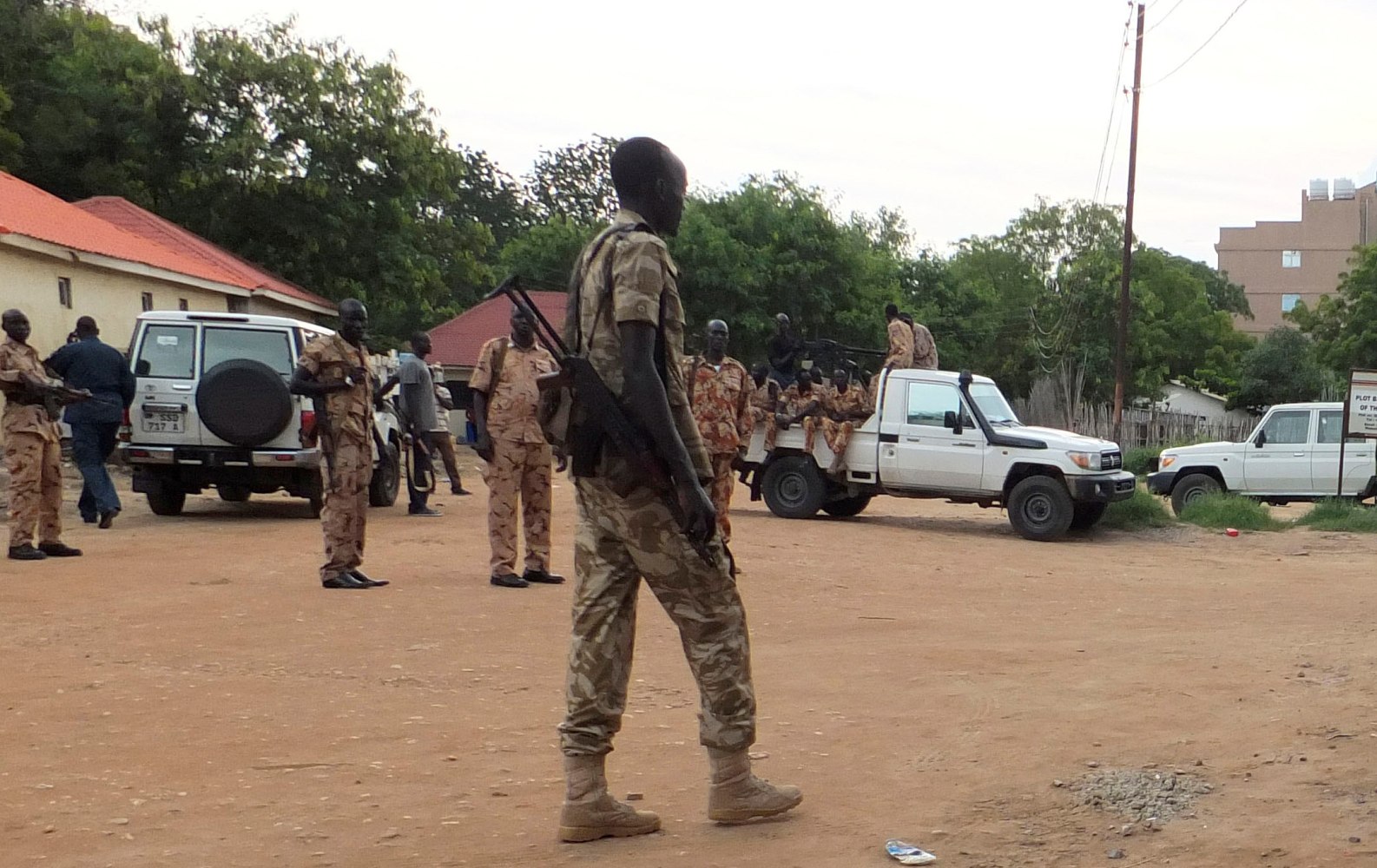
On July 11, South Sudanese troops, fresh from winning a battle in the capital, Juba, over opposition forces, went on a nearly four-hour rampage through a residential compound popular with foreigners, in one of the worst targeted attacks on aid workers in South Sudan's three-year civil war.
They shot dead a local journalist while forcing the foreigners to watch, raped several foreign women, singled out Americans, beat and robbed people and carried out mock executions, several witnesses told The Associated Press.
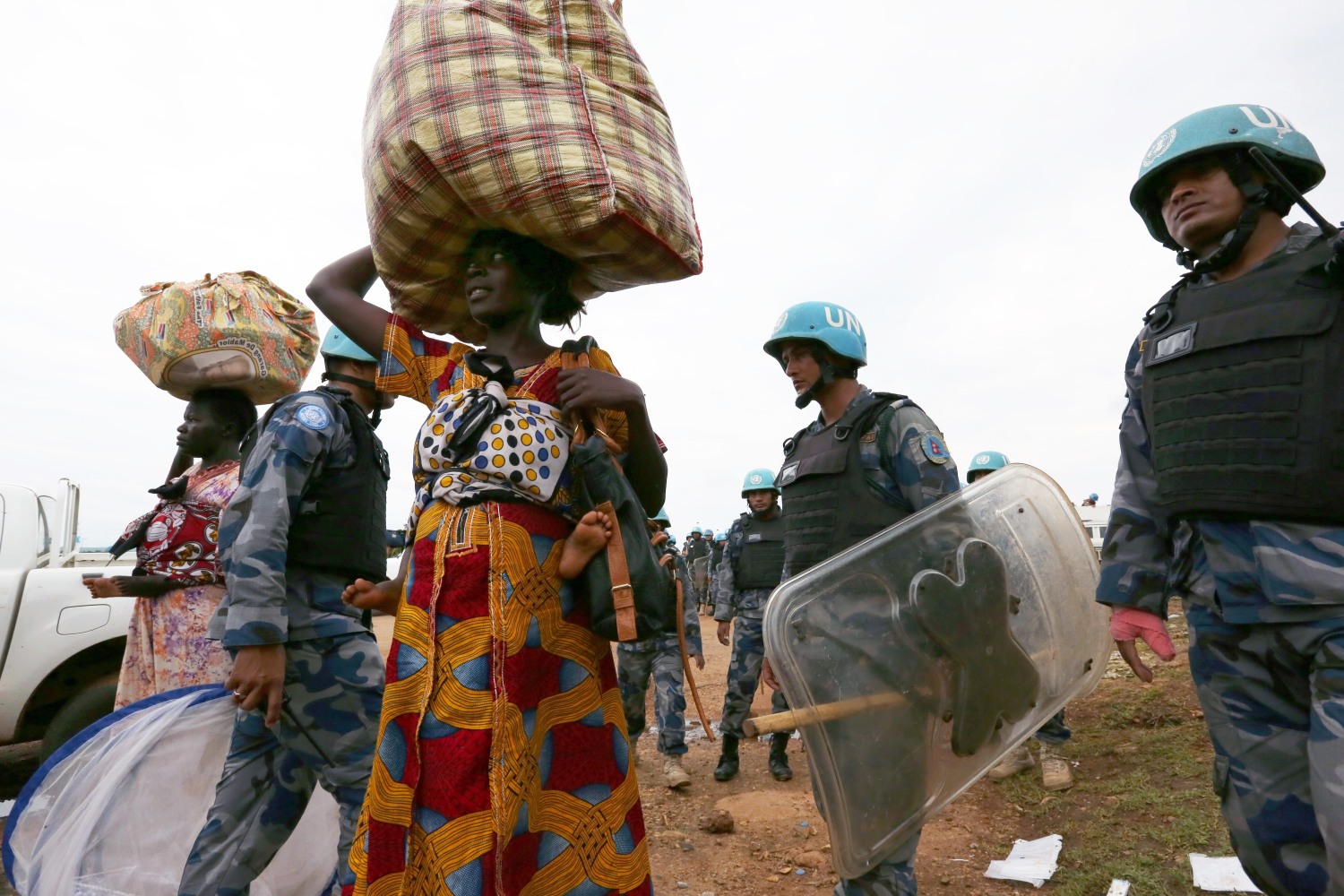
For hours throughout the assault, the U.N. peacekeeping force stationed less than a mile away refused to respond to desperate calls for help. Neither did embassies, including the U.S. Embassy.
The Associated Press interviewed by phone eight survivors, both male and female, including three who said they were raped. The other five said they were beaten; one was shot. Most insisted on anonymity for their safety or to protect their organizations still operating in South Sudan. AP does not identify victims of sexual assault.


The accounts highlight, in raw detail, the failure of the U.N. peacekeeping force to uphold its core mandate of protecting civilians, notably those just a few minutes' drive away. U.N. peacekeepers in Juba have already been accused of not acting to stop the rapes of local women by soldiers outside the U.N.'s main camp and within their sight last month.
The attack on the Terrain hotel complex shows the hostility toward foreigners and aid workers by troops under the command of South Sudan's President Salva Kiir, who has been fighting supporters of rebel leader Riek Machar since civil war erupted in December 2013. Both sides have been accused of abuses. The U.N. recently passed a U.S. resolution to send more peacekeeping troops to protect civilians.


Army spokesman Lul Ruai did not deny the attack at the Terrain but said it was premature to conclude the army was responsible. "Everyone is armed, and everyone has access to uniforms and we have people from other organized forces, but it was definitely done by people of South Sudan and by armed people of Juba," he said.
A report on the incident compiled by the Terrain's owner at Ruai's request, seen by the AP, alleges that at least five women were raped, torture, mock executions, beatings and looting. An unknown number of South Sudanese women were also assaulted.

The attack came just as people in Juba were thinking the worst was over.

Three days earlier, gunfire had erupted outside the presidential compound between armed supporters of the two sides in South Sudan's civil war, at the time pushed together under an uneasy peace deal. The violence quickly spread across the city.


Throughout the weekend, bullets whizzed through the Terrain compound, a sprawling complex with a pool, squash court and a bar patronized by expats and South Sudanese elites. It is also in the shadow of the U.N.'s largest camp in Juba.
By Monday, the government had nearly defeated the forces under Machar, who fled the city. As both sides prepared to call for a cease-fire, some residents of the Terrain started to relax.
"Monday was relatively chill," one survivor said.
What was thought to be celebratory gunfire was heard. And then the soldiers arrived. A Terrain staffer from Uganda said he saw between 80 and 100 men pour into the compound after breaking open the gate with gunshots and tire irons. The Terrain's security guards were armed only with shotguns and were vastly outnumbered. The soldiers then went to door to door, taking money, phones, laptops and car keys.


"They were very excited, very drunk, under the influence of something, almost a mad state, walking around shooting off rounds inside the rooms," one American said.
One man wore a blue police uniform, but the rest wore camouflage, the American said. Many had shoulder patches with the face of a tiger, the insignia worn by the president's personal guard.
For about an hour, soldiers beat the American with belts and the butts of their guns and accused him of hiding rebels. They fired bullets at his feet and close to his head. Eventually, one soldier who appeared to be in charge told him to leave the compound. Soldiers at the gate looked at his U.S. passport and handed it back, with instructions.
"You tell your embassy how we treated you," they said. He made his way to the nearby U.N. compound and appealed for help.
Meanwhile, soldiers were breaking into a two-story apartment block in the Terrain which had been deemed a safe house because of a heavy metal door guarding the apartments upstairs. Warned by a Kenyan staffer, more than 20 people inside, most of them foreigners, tried to hide. About 10 squeezed into a single bathroom.
The building shook as soldiers shot at the metal door and pried metal bars off windows for more than an hour, said residents. Once inside, the soldiers started ransacking the rooms and assaulting people they found.


Some of the soldiers were violent as they sexually assaulted women, said the woman who said she was raped by 15 men. Others, who looked to be just 15 or 16 years old, looked scared and were coerced into the act.
"One in particular, he was calling you, 'Sweetie, we should run away and get married.' It was like he was on a first date," the woman said. "He didn't see that what he was doing was a bad thing."
After about an hour and a half, the soldiers broke into the bathroom. They shot through the door, said Jesse Bunch, an American contractor who was hit in the leg.
"We kill you! We kill you!" the soldiers shouted, according to a Western woman in the bathroom. "They would shoot up at the ceiling and say, 'Do you want to die?' and we had to answer 'No!'"
The soldiers then pulled people out one by one. One woman said she was sexually assaulted by multiple men. Another Western woman said soldiers beat her with fists and threatened her with their guns when she tried to resist. She said five men raped her.


During the attack on the Terrain, several survivors told the AP that soldiers specifically asked if they were American. "One of them, as soon as he said he was American, he was hit with a rifle butt," said a woman.
When the soldiers came across John Gatluak, they knew he was local. The South Sudanese journalist worked for Internews, a media development organization funded by USAID. He had taken refuge at the Terrain after being briefly detained a few days earlier. The tribal scars on his forehead made it obvious he was Nuer, the same as opposition leader, Riek Machar.


Upon seeing him, the soldiers pushed him to the floor and beat him, according to the same woman who saw the American beaten.
Later in the attack, and after Kiir's side declared a ceasefire at 6 p.m., the soldiers forced the foreigners to stand in a semi-circle, said Gian Libot, a Philippines citizen who spent much of the attack under a bed until he was discovered.
One soldier ranted against foreigners. "He definitely had pronounced hatred against America," Libot said, recalling the soldier's words: "You messed up this country. You're helping the rebels. The people in the U.N., they're helping the rebels."
During the tirade, a soldier hit a man suspected of being American with a rifle butt. At one point, the soldier threatened to kill all the foreigners assembled. "We're gonna show the world an example," Libot remembered him saying.
Then Gatluak was hauled in front of the group. One soldier shouted "Nuer," and another soldier shot him twice in the head. He shot the dying Gatluak four more times while he lay on the ground.


"All it took was a declaration that he was different, and they shot him mercilessly," Libot said.
The shooting seemed to be a turning point for those assembled outside, Libot said. Looting and threats continued, but beatings started to draw to a close. Other soldiers continued to assault men and women inside the apartment block.
From the start of the attack, those inside the Terrain compound sent messages pleading for help by text and Facebook messages and emails.
"All of us were contacting whoever we could contact. The U.N., the U.S. embassy, contacting the specific battalions in the U.N., contacting specific departments," said the woman raped by 15 men.
A member of the U.N.'s Joint Operations Center in Juba first received word of the attack at 3:37 p.m., minutes after the breach of the compound, according to an internal timeline compiled by a member of the operations center and seen by AP.
Eight minutes later another message was sent to a different member of the operations center from a person inside Terrain saying that people were hiding there. At 4:22 p.m., that member received another message urging help.
Five minutes after that, the U.N. mission's Department of Safety and Security and its military command wing were alerted. At 4:33 p.m., a Quick Reaction Force, meant to intervene in emergencies, was informed. One minute later, the timeline notes the last contact on Monday from someone trapped inside Terrain.
For the next hour and a half the timeline is blank. At 6:52, shortly before sunset, the timeline states that "DSS would not send a team."
About 20 minutes later, a Quick Reaction Force of Ethiopians from the multinational U.N. mission was tasked to intervene, coordinating with South Sudan's army chief of staff, Paul Malong, who was also sending soldiers. But the Ethiopian battalion stood down, according to the timeline. Malong's troops eventually abandoned their intervention too because it took too long for the Quick Reaction Force to act.


The American who was released early in the assault and made it to the U.N. base said he also alerted U.N. staff. At around dusk, a U.N. worker he knew requested three different battalions to send a Quick Reaction Force.
"Everyone refused to go. Ethiopia, China, and Nepal. All refused to go," he said.
Eventually, South Sudanese security forces entered the Terrain and rescued all but three Western women and around 16 Terrain staff.
No one else was sent that night to find them. The U.N. timeline said a patrol would go in the morning, but this "was cancelled due to priority." A private security firm rescued the three Western women the staffers the next morning.
When asked why the U.N. peacekeeping mission didn't respond to the repeated requests for help, acting spokeswoman Yasmina Bouziane said the circumstances are under investigation.
"The peacekeepers did not venture out of the bases to protect civilians under imminent threat," Human Rights Watch said Monday in a report on abuses throughout Juba.
The U.S. Embassy, which also received requests for help during the attack, did not respond to repeated requests for comment.
The assault at the Terrain pierced a feeling of security among some foreigners who had assumed that they would be protected by their governments or the hundreds of U.N. peacekeepers almost next door.
One of the women gang-raped said security advisers from an aid organization living in the compound told residents repeatedly that they were safe because foreigners would not be targeted. She said: "This sentence, 'We are not targeted,' I heard half an hour before they assaulted us."

Make Mine Freedom - 1948


American Form of Government

Who's on First? Certainly isn't the Euro.